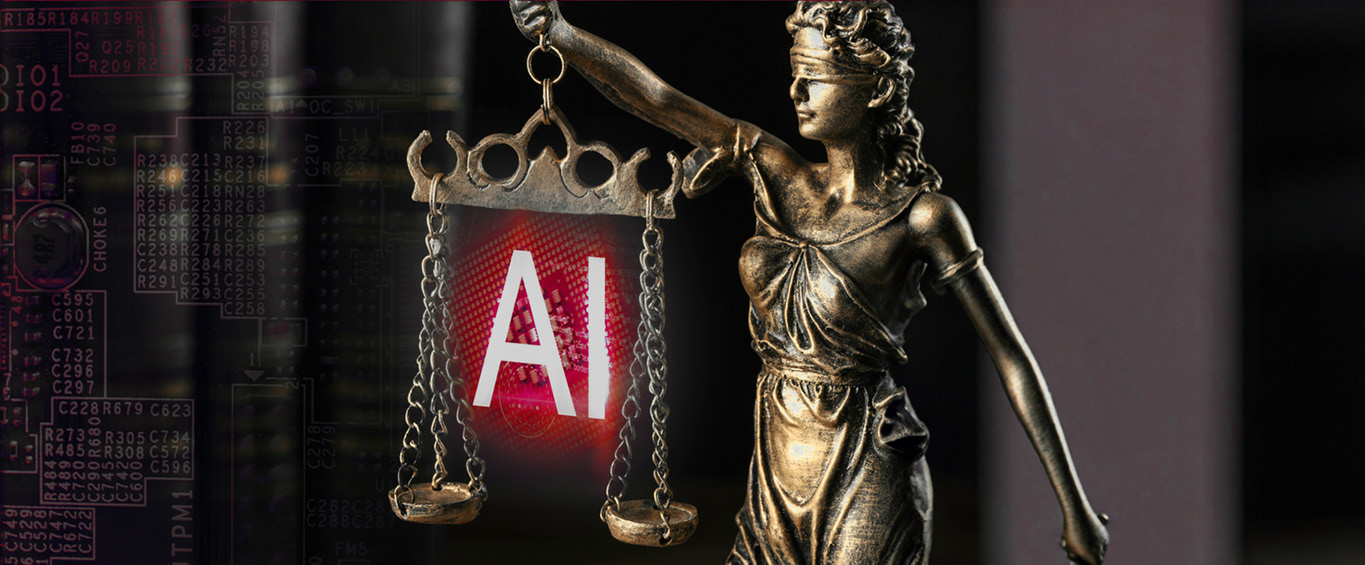
Simple, fast, cost-effective: AI tools can now translate entire documents in mere seconds. But the crucial question that must be asked is: Who is liable for AI translations if something goes wrong?
In a corporate environment in particular, translation is more than just language – it involves both legal and economic responsibility. Incorrect translations can obfuscate contracts, render product instructions unusable, damage a brand’s reputation or even, in the very worst case, lead to personal injury. And for liability cases? It’s not the AI, but you as the user who bears responsibility.
The risk: Liability for AI translations
Many companies now use AI tools on the fly and independently of existing processes. However, these tools do not assume any responsibility, nor do they offer any warranties.
Most providers will clearly state “Liability excluded” in their terms and conditions. If incorrect or misleading translations result in financial losses, these have to be borne by the company that used AI.
Added to this is the issue of data protection. Anyone who uploads internal or confidential documents to a public AI system is, in effect, passing this data on to third parties. This may not only violate internal security policies, but also the European General Data Protection Regulation, or GDPR for short.
In short, the combination of liability gaps and data protection risks means that using uncontrolled AI translations can pose a genuine risk – especially in regulated industries.
Professional alternatives: Responsibility included
As a certified language service provider, we see AI as a tool – not as a substitute for professional service. Our service promise:
Technological efficiency, human validation and legal responsibility.
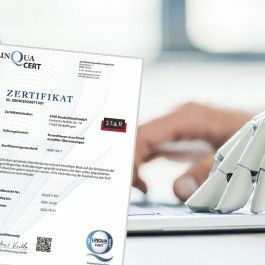
We work in accordance with ISO 17100 and use structured processes to ensure that every translation is technically accurate and consistent as well as being legally compliant.
The key difference is that we take responsibility for the results and vouch for them because our translations are documented, checked and approved.
Human-in-the-loop: The balance of man and machine
Our answer to the question of liability for AI translations is simple: keeping humans in the loop.
We use AI where it makes sense – in pretranslation, terminology work or quality assurance – but never without final verification carried out by a human.
Every translation is checked, revised and approved by experienced specialist translators.
This allows our customers to benefit from increased efficiency without compromising quality, data protection or legal security.
How we intelligently integrate AI
AI is an integral part of our workflow – but only within protected, certified systems. We use AI for:
- Machine pretranslation combined with post-editing by our specialist translators.
- Terminology extraction to automatically recognise relevant terms.
- Terminology replacement and terminology checking to ensure consistent wording.
- Harmonisation, i.e. implementing style guidelines and layout specifications.
This approach saves time and maintains quality whilst also ensuring complete traceability. AI provides support – but humans make the decisions.
CAT tool or AI tool? A crucial difference
Many people confuse computer-assisted translation tools (or CAT tools for short) with AI tools. But these tools differ in quite significant ways.
| Aspect | CAT tool | AI tool (free or web-based) |
| Purpose | Support for professional translation processes | Instant translations for end users |
| Data sovereignty | Local or GDPR-compliant environment | Cloud-based, unknown data paths |
| Translation memory (TM) | Customer-specific, well-maintained language archive | No long-term storage |
| Terminology management | Use of approved technical terminology | No checks or approval processes |
| Quality assurance | Integrated checking tools, human-in-the-loop | No checks or liability |
| Liability | Service provider assumes responsibility | Excluded in the terms and conditions |
Translation memory as a repository of quality work
A tool such as TransitNXT is more than just software – it is a process anchor. It stores verified translations in the translation memory (abbreviated to TM) and links them to approved terminology and allows for machine-translation suggestions to be integrated in a controlled manner.
This enables us to achieve consistent terminology, unified corporate language and efficiency in the long term.
In the context of TM, AI suggestions are always checked, harmonised and adapted as required.
This ensures that every project remains consistent, traceable and legally compliant. AI systems, on the other hand, operate in isolation: They simply produce texts – they don’t take responsibility for the resulting translations.
Legal reality: AI is not liable
The legal situation is also unequivocal. An AI cannot be a contractual partner or assume responsibility. If an incorrect translation causes damage – for example, through incorrect safety information, faulty assembly instructions or ambiguous commercial clauses – the company that used the AI remains liable.
A professional provider, on the other hand, offers documented quality assurance, version history, traceable testing processes and is also covered by public liability insurance should this ever be required.
This is the only way to ensure legal and liability security – as guaranteed by ISO-certified language service providers such as STAR Deutschland.
AI does not replace human discernment
Modern AI systems can imitate syntax and style, but cannot develop an awareness of context, culture or intention.
Our translators recognise when terms have different legal or technical meanings, when irony in marketing texts must be preserved, or when something needs to be adapted to the culture of the target readership.
This form of language is not the product of pure data processing – it is the result of professional experience.
That is the difference between a generated text and a responsible translation.
Summary: Checks create liability security
AI-assisted translation presents an opportunity – but offers no guarantees.
Anyone who produces translations in a fully automatic process must understand that AI systems bear absolutely no responsibility for the output.
Our approach combines the best of both worlds:
- AI for speed and efficiency,
- CAT tools for consistency and traceability,
- Humans for quality, responsibility and cultural understanding.
This is how we ensure that every translation is legally compliant, linguistically accurate and fully in line with data protection regulations.
Because our motto is: AI supports – people safeguard.
This is the only way to achieve real certainty with regard to liability for AI translations.