Products are becoming ever more complex, regulatory requirements are increasing, and international markets expect consistent communication in numerous languages. At the same time, many businesses are facing a familiar problem: Technical documentation is increasingly becoming a bottleneck.
A lack of resources, tight deadlines and increasing documentation requirements often result in products being launched on the market later than scheduled. Yet technical documentation is far more than just an obligation. It forms an integral part of the product itself and influences product safety, customer satisfaction and international market success.
In this article, you’ll find out why more and more companies are outsourcing their technical writing and what specific benefits this offers.
Technical writing: The bridge between development and the user
Specific examples of technical documentation include:
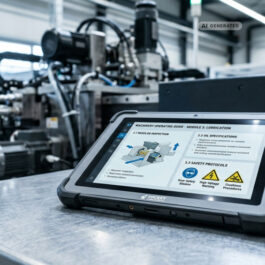
- Operating, assembly and maintenance manuals
- Online help files and knowledge bases
- Service and training documentation
- Safety instructions and warning information
- Documentation for international markets
- Structuring and managing product information
The efficient organisation of information is becoming increasingly important, particularly for businesses with a broad product portfolio. Modern methods such as structured authoring, DITA or XML-based content management systems make it possible to manage content centrally, reuse it and deliver it consistently across a variety of channels. This reduces redundancies, speeds up updates and lowers documentation costs in the long term.
Why companies are increasingly outsourcing their technical writing
The demands placed on technical documentation are continually increasing. At the same time, it is often not worth setting up large teams of in-house writers. Recruiting and training staff is often too time-consuming, and fluctuating order volumes can quickly lead to a team becoming either overwhelmed or underutilised. Collaborating with a specialist service provider therefore offers numerous benefits.
Flexibility when the workload fluctuates
The demand for documentation often rises dramatically before a product is released, certified or launched on a market. During quieter phases of a project, however, these resources are not required. Outsourcing enables companies to dynamically adapt their capacity to the current level of demand without having to employ additional permanent staff. What’s the benefit to you? Greater scalability combined with better cost control.
Immediate access to expert knowledge and the latest technologies
Technical documentation is constantly evolving. Topics such as single-source publishing, component content management, terminology management and AI-assisted processes require specialist expertise.
An experienced service provider will already have:
- Established editorial processes
- Expertise in the latest tools
- Experienced technical writers
- Proven quality standards
- Up-to-date industry knowledge
This enables companies to benefit directly from modern methods without having to roll out complex systems or recruit additional staff.
Better quality and compliance
Incorrect or incomplete documentation can have far-reaching consequences:
- Increased liability risks
- Safety issues affecting users
- Higher support costs
- Complaints arising from audits or certification processes
Professional technical writing service providers have standardised quality processes and in-depth knowledge of the relevant standards and directives, meaning that the documentation produced is consistent and complies with standards for all manner of target markets.
Faster time to market – even for international product launches
For companies operating on the global stage, the challenge is not limited to document creation. The content must be translated and localised into numerous languages – and it’s not enough to simply translate the technical terms. Different markets have their own linguistic, cultural and regulatory requirements.
The process becomes particularly efficient when technical writing and translation are closely intertwined. Structured content, terminology management and standardised workflows ensure:
- Consistent technical terminology in the source and target languages
- Lower translation costs
- Faster approval processes
- Higher quality in all target languages
All this makes it far easier to manage international product launches.
The future is smart: AI in technical writing

It’s true that artificial intelligence is changing the face of the technical documentation creation process. However, it’s simply no substitute for experienced technical writers. Companies can yield the greatest benefits when human expertise and intelligent technologies join forces.
AI is particularly well suited to:
- Analysis of existing content
- Identification of content gaps
- Checking terminology
- Structuring large amounts of information
- Providing support with routine documentation tasks
Human expertise remains indispensable for:
- Safety-related content
- Legally sensitive documentation
- Communication intended for a specific target audience
- Technical plausibility checks
- Editorial quality assurance
Judicious use of AI significantly speeds up processes. However, the responsibility for ensuring that documentation is clear, legally compliant and of a high standard remains in experienced human hands.
Practical example: Typical challenges in technical documentation
Many industrial companies face similar problems:
- Product information is stored in various systems.
- Documentation is created and maintained multiple times.
- Translations incur high costs.
- Release dates are delayed due to a lack of documentation.
- International markets are requiring ever more language versions.
Structured editorial processes and centralised content management can help to reduce these challenges in the long term. At the same time, the reusability of content is increasing, which significantly speeds up the creation of new documentation.
In summary: Outsourcing frees up capacity for your core business
Technical documentation plays a key role in safety, compliance and market success. Companies that outsource their technical writing to a specialist partner benefit from:
✅ Greater flexibility
✅ Faster time to market
✅ Professional quality standards
✅ More efficient translation processes
✅ Better international scalability
✅ Access to the latest technologies and AI-assisted workflows
This creates a decisive competitive advantage, particularly for companies operating on the international stage: You can focus on development, production and sales, whilst a team of experts professionally manages your technical documentation.
Would you like to optimise your documentation processes and scale them globally?
Would you like to find out whether outsourcing your technical writing would be a more cost-effective approach?
STAR Deutschland supports companies in the creation, structuring, localisation and management of technical documentation. Our experts can analyse your existing processes and identify the potential for greater efficiency, higher quality and faster international roll-outs.
Book a no-obligation consultation now and find out how you can future-proof your documentation: Technical documentation