16 Jun 2026

Chinese Advertising Law: What companies need to bear in mind when translating for the Chinese market

For many companies around the globe, China is one of the most important export markets. However, what works perfectly well in the Anglosphere and beyond can pose legal risks in China. Advertising copy, product descriptions, website content and social media campaigns, in particular, must comply with Chinese requirements.
 

What is the Chinese Advertising Law?

The Chinese Advertising Law sets out what advertising claims companies are permitted to make to consumers and what content is considered misleading or unlawful.

The aim of the law is to protect consumers from:

  • misleading advertising claims
  • unverifiable claims
  • unfair competitive advantages
  • hidden advertising
 

For international companies, this means that marketing copy often needs to be adapted before it is launched on the Chinese market.
 

Superlatives and claims of uniqueness? Proceed with caution…

One particularly well-known aspect of Chinese Advertising Law concerns ‘absolute’ advertising claims.

Phrases such as:

  • “the best”
  • “world leader”
  • “number 1”
  • “top quality”
  • “unbeatable”
  • “market-leading”
 

can be problematic if they cannot be clearly substantiated.

Whilst such statements are pretty commonplace in Western marketing campaigns, the Chinese authorities scrutinise this sort of wording much more closely.

When it comes to translation projects, this means that not every advertising claim should be translated word for word into Chinese. It is often more sensible to render the advertising message using legally compliant phrasing than to provide a more direct translation.
 

Practical examples

Case 1 – Problematic advertising using superlatives

A German car manufacturer promoted its vehicles in China with the slogan “at the very highest level”. This was classified by the Chinese authorities as an impermissible absolute advertising claim and resulted in a fine of ¥600,000 (approx. €76,000). In China, any such performance claim must always be verifiable – simply translating Western marketing messages word for word is not an option.

Case 2 – Improper use of the Chinese national flag

One particularly sensitive issue concerns the use of national symbols. An international technology group used an illustration on its Chinese website that featured elements of the Chinese national flag. This led to a complaint by a competitor. The consequence? Despite this slip-up being entirely unintentional, the website was taken offline for six months – a disaster for the business in one of its key markets.

Although this sort of breach is often overlooked, it can prove extremely costly if it is challenged. Article 9.1 of the Chinese Advertising Law expressly prohibits the overt or covert use of the national flag, the national anthem or the coat of arms of the People’s Republic of China.

The legal consequences could be even more severe: In the event of serious breaches, fines of up to ¥2 million (approx. €256,000) may be imposed; in extreme cases, the business licence may even be revoked.
 

New rules for online advertising since 2023

The digitalisation of the Chinese market has led to tighter regulation of online advertising. The new “Measures for the Administration of Internet Advertising” issued by the Chinese State Administration for Market Supervision (SAMR) have been in force since 1st May 2023.

The following are particularly affected:

  • Company websites
  • Search engine advertising
  • Social media campaigns
  • E-commerce platforms
  • Mobile apps
  • Influencer marketing
  • Live-stream commerce
 

Advertising content must be clearly identifiable to users. Hidden forms of advertising and disguised product placement are increasingly coming under scrutiny from the authorities.

For businesses, this means that translated landing pages, product pages and social media content must also meet local requirements.

 

Mehrere Personen analysieren an einem Multi‑Monitor‑Arbeitsplatz digitale Inhalte und Kennzeichnungen im Rahmen der Überwachung und Prüfung von Werberichtlinien im internationalen Kontext.

Influencer marketing and KOL campaigns under scrutiny

China is one of the world’s largest markets for influencer marketing. Key Opinion Leaders (KOLs) and Key Opinion Consumers (KOCs) play a key role in purchasing decisions.

At the same time, regulatory requirements have become more stringent.

Advertising content must be clearly identifiable as advertising. This applies in particular to:

  • Product recommendations
  • Testimonials
  • Product reviews
  • Live-stream presentations
  • Affiliate campaigns
 

Businesses should therefore ensure that not only the translation but also the legal drafting of such content is reviewed.
 

What role does translation play?

Many breaches of the Chinese Advertising Law are not a result of malicious intent, but from sticking too closely to the phrasing of the original Western marketing texts.

Typical examples:

Original marketing textPotential challenge in China
“…a market leader in Europe…”Burden of proof
“…offers top quality…”Problematic superlative
“…the world’s only…”Absolute advertising claim
“…guaranteed to be the best solution…”Performance promise that is hard to substantiate
“…100% safe…”Risky statement

Professional localisation takes these risks into account right from the start of the translation process.

This helps to avoid alterations, legal disputes or costly corrections down the line.
 

Why localisation is more important than ‘standard’ translation

The Chinese market demands more than just a literal translation of content.

Successful localisation takes the following into account:

  • Cultural expectations of Chinese target audiences
  • Local communication styles
  • Search engine optimisation for the Chinese market
  • Industry-specific terminology
  • Regulatory requirements such as the Chinese Advertising Law
 

This can make all the difference to market success, particularly when it comes to websites, product catalogues, brochures and online marketing materials.
 

Our recommendations for entering the Chinese market

Before using marketing materials for the Chinese market, be sure to have them reviewed by experts with in-depth knowledge of Chinese Advertising Law.
Particular caution is required when it comes to AI-assisted or fully automated translations. Especially when translating German or English advertising copy into Chinese word for word, there is a high risk of breaching Chinese advertising law, which can lead to serious consequences.
A professional transcreation or localisation – a culturally sensitive adaptation rather than a literal translation – can prevent costly legal disputes and damage to your reputation.

At STAR Deutschland, we have a network of native speakers with specialist expertise in Chinese Advertising Law. Our colleagues based in China are familiar with the current regulations and can ensure that your message is legally compliant and culturally appropriate.

Would you like to find out more about legally compliant communication for the Chinese market? Get in touch to receive tailored advice.


28 May 2026

AI-assisted translation systems offer impressive opportunities to speed up multilingual processes – but their effectiveness depends crucially on carefully considered terminology management.

27 Jan 2026

Simple, fast, cost-effective: AI tools can now translate entire documents in mere seconds. But the crucial question that must be asked is: Who is liable for AI translations if something goes wrong?

18 Dec 2025

Technical language thrives on precision. In documentation, service and in product descriptions, every single word matters – one or two nuances in meaning can make the difference between correct operation and malfunction.

27 Nov 2025

E-learning is considered a central pillar of continuing professional development in many companies – from global onboarding courses to complex product training. At the same time, projects repeatedly face similar challenges.

30 Oct 2025

Terminology work has always been the key to consistent, high-quality translations. The advent of AI and large language models (LLMs) is fundamentally changing translation processes.

7 Oct 2025

The world’s biggest conference for technical communication will be held in Stuttgart from 11th to 13th November.
Visit us at tekom in the foyer at stand 21

28 Jul 2025

In less than 4 months, the next tekom annual conference is set to open in Stuttgart. The world’s biggest conference for technical communication will be held in Stuttgart from 11th to 13th November.

8 Jul 2025

This year’s MT Summit was held in Geneva, Switzerland, and featured a diverse programme of tutorials, workshops and inspiring presentations on the topics of machine translation (MT) and large language models (LLMs).

24 Jun 2025

If you have ever had a text translated into Polish, translated it yourself or have had anything else to do with Slavic languages, you may have come across a linguistic phenomenon that we are unfamiliar with in English – aspect.

24 Apr 2025

As a professional language service provider, we encounter the challenges and subtleties of a wide variety of languages each and every day. One language that has been attracting more and more attention in recent years due to economic, cultural and political developments is Korean.

26 Feb 2025

AI: What started as a buzzword, and then became an established term in everyday language, is now a basic requirement for many applications and processes.

16 Dec 2024

Another year is drawing to a close, and we can hardly believe how fast the time has flown by. Now is a good opportunity to take a look back at all of the important developments that 2024 – the year of AI – has brought us, and give you an insight into what next year has in store for us.

25 Nov 2024

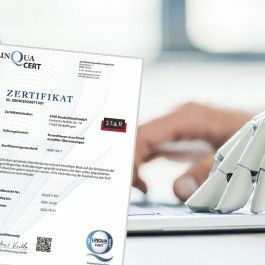
This year, STAR Deutschland GmbH once again welcomed its independent certification partner LinquaCert to its Sindelfingen office for the ISO 18587:2017 surveillance audit (“Post-editing of machine translation output”) shortly before the annual tekom conference.

28 Oct 2024

Can AI help to create high-quality content in any language while adhering to corporate language and specific rules?

1 Aug 2024

In the fast-paced world of the translation and localisation industry, efficiency is the key to success. One solution that can play an important role in delivering this efficiency is the Common Translation Interface (COTI) standard.

18 Jul 2024

We are pleased to announce that we have passed the ISO 27001 surveillance audit for our information security management system without any discrepancies!

7 May 2024

According to the recently published 2024 Slator and Nimdzi indices, the STAR Group is one of the top 25 language service providers in the world. In the DACH region (Germany, Austria and Switzerland), STAR takes the top spot in terms of audited turnover!

25 Apr 2024

CyberVadis, an independent provider which analyses and assesses cybersecurity in companies, has given STAR top marks for its cybersecurity strategies and measures!

11 Mar 2024

Large language models (LLMs) could prove to be valuable assets for linguists in the context of language processes. But what exactly are the advantages of this technology?

27 Feb 2024

Few words have characterised the year 2023 as much as “AI”.
But what does this buzzword actually mean for translation and language processes?

30 Jan 2024

You can tell how diverse a language is just by looking at the breadth of its idioms. These turns of phrase vividly describe emotions or situations, often through associations with the animal world

7 Dec 2023

Just a few days before the 2023 edition of the annual tekom conference, STAR Deutschland GmbH succeeded once again in earning the seal of approval of its independent certification partner LinquaCert in the surveillance audit for ISO 18587:2017 “Post-editing of machine translation output”, confirming the continued high quality and transparency of the company’s translation processes!

23 Oct 2023

Digitalisation, automation and artificial intelligence are playing a key role in more and more industries in the long term. In this context, and with the development of machine translation (MT), the translation profession has also changed significantly.

5 Oct 2023

Supplier selection is a significant factor in the success of a business.
In this article, we will give you clear pointers and tips for choosing a translation service provider.

9 May 2023

Supplier selection is a significant factor in the success of a business.
In this article, we will give you clear pointers and tips for choosing a translation service provider.

15 Apr 2023

Be honest: Is your company Fort Knox when it comes to security against external attacks? Or might there be a hole in your defences somewhere? This article shines a light on why you should keep IT security in mind when you are choosing your language service provider.

1 Feb 2023

Short, interesting videos on websites grab the interest of potential customers and increase traffic. Millions of videos are watched every day on social media sites such as YouTube, Facebook, etc. You should also make your videos available not just in your native language, but also in other languages for all your target audiences and markets so that you can achieve a greater reach.

23 Nov 2022

As part of our main audit in October, we were able to demonstrate our expertise in machine translation (MT) to our certification partner LinquaCert; expertise that we have built over more than 15 years.

15 Oct 2022

“Why is Japanese so expensive in comparison to other Asian languages?” – this is a question that we are regularly asked by customers, and by colleagues too. Yet it cannot be answered in a single sentence.

6 Jul 2022

Fabienne, Nadège and Frank are specialist translators for STAR Deutschland, working into their mother tongue, French. In this interview, they tell us about their job, their daily work life and the challenges and experiences that they have encountered over time.

14 Apr 2022

We are pleased to announce that we were successful in our surveillance audit, conducted on 31 March and 1 April 2022 by two auditors from PÜG Prüf und Überwachungsgesellschaft mbH.

2 Feb 2022

As a customer, you expect only the very best quality from your suppliers.
Providing high-quality translations can prove problematic for many service providers.

How can quality be guaranteed through translation management?
How can quality issues be rectified in the long term?

Find out more in this interview with Dr. Glenda O., our Quality Management Officer.

25 Jan 2022

What website operator doesn’t dream of their site appearing at the very top of web search results?

If you want to convince users across the globe to click on your localised website, view your products and services, and better still, make a purchase, we can show you how. With a translation process that takes into account SEO optimisation, you can save your marketing budget and win customers.

15 Jul 2021

This proves that information security is a top priority within our organisation.

5 Mar 2020

Do you use Chinese translations as part of your marketing campaigns in the Chinese market? Then you should get advice from STAR about the Chinese Advertisement Law.

Subscribe to newsletter

Receive regular bulletins about STAR products, services, innovations and much more.